If You Grew Up in Michigan, You Definitely Know Him: The Enduring Legacy of Big Boy
For generations of Michiganders, the sight of a rosy-cheeked, pompadoured boy in red-checkered overalls hoisting a towering double-decker burger is far more than a restaurant logo. It is a portal to childhood. It is the promise of a Friday night dinner with the family, a post-game celebration, a birthday sundae, and a simpler time when a fiberglass giant standing beside a parking lot could feel like a friendly landmark. If you grew up in Michigan, you definitely know him. You know the curl of his hair, the gleam of his painted smile, and the way his outstretched arm seems to welcome you into a world of diner coffee, pressed sandwiches, and hot fudge cake. He is Big Boy, and while his origins are Californian, his soul—at least for millions of Americans—is unmistakably Midwestern.
This is the story of how a small hamburger stand in Glendale, California, became a Michigan institution; how a real six-year-old boy inspired an icon; how a fiberglass statue became a piece of roadside folklore; and how a brand that once operated hundreds of locations continues to stir deep nostalgia even as many of its familiar restaurants have faded from the landscape. It is a story about burgers and business, but also about memory, place, and the peculiar power of a smiling mascot to make us feel like we are home.
The Californian Seed: Bob Wian and the Birth of a Burger Empire
The story begins not in the Midwest, but in the sun-drenched sprawl of Southern California in the mid-1930s. In 1936, a young man named Bob Wian sold his prized DeSoto Roadster to purchase a small, ten-stool hamburger stand in Glendale. He named it Bob’s Pantry. It was a humble beginning, the kind of origin story that seems almost mythic in retrospect. Wian was not a corporate titan; he was a hands-on operator, a man who knew his customers by name and understood that a good burger could be a powerful thing.
The following year, a regular customer made a request that would change everything. He wanted something different. Wian went to work, slicing a bun into three layers, adding two beef patties, and creating what is widely considered the first double-decker cheeseburger. The creation was an instant hit, a messy, glorious stack of beef, cheese, lettuce, and sauce that demanded two hands and a hearty appetite. But the burger needed a name, and the name came from an unexpected source: a chubby six-year-old boy named Richard Woodruff.
According to restaurant lore, young Richard was a fixture at the stand, a self-appointed “superfan” who would hang around and offer to sweep up in exchange for one of the new double burgers. Wian was charmed by the boy’s enthusiasm. One day, according to the story, Wian greeted him with a simple, “Hello, Big Boy,” and the name stuck. The burger became the Big Boy, and the boy became the inspiration for the mascot that would soon adorn menus, signs, and eventually, towering fiberglass statues across the country.
From Napkin Sketch to National Icon
The visual identity of Big Boy was solidified not by a corporate branding agency, but by a Hollywood animator. A regular customer—Ben Washam, who worked at Warner Brothers—sketched a caricature of young Richard Woodruff on a napkin. The drawing captured the essence of the boy: the rounded cheeks, the mischievous grin, the checkered overalls, and the triumphant pose of a server holding a burger aloft. That napkin sketch became the blueprint for one of the most recognizable mascots in American food history.
The character was refined over time, but the core elements remained: the dark, wavy pompadour hair (in the most famous iteration), the red-and-white checkered overalls, the white t-shirt, and the ever-present Big Boy burger held high like a trophy. It was a design that communicated friendliness, abundance, and a kind of innocent American optimism. As the chain expanded through franchising, the mascot went with it, adapting slightly to regional tastes but always retaining that unmistakable silhouette.
The Michigan Story: Elias Brothers and the Making of a Regional Powerhouse
While Big Boy was born in California, it grew up in Michigan. The crucial turn came in 1952, when three brothers—John, Louis, and Fred Elias—became the first to formally apply to Bob Wian for a Big Boy franchise license. The Elias brothers were not newcomers to the restaurant business. They had opened Fred’s Chili Bowl in Detroit in 1938, learning the trade in the tough, competitive world of mid-century Detroit dining. Their restaurant, the Dixie Drive-In in Hazel Park, Michigan, became the first official Big Boy franchise.
The timing was fortuitous. Postwar America was embracing the automobile, the suburbs, and the family dinner out. The Elias brothers understood the Michigan market intimately. They opened restaurants bearing the “Elias Brothers Big Boy” name, and they expanded aggressively. By 1964, they had opened 100 restaurants throughout Michigan and Ohio. These were not just places to eat; they were community hubs, gathering spots for little league teams, church groups, and families celebrating report cards and birthdays.
The Elias brothers’ influence on the brand was profound. In 1987, they purchased the entire Big Boy chain from Marriott Corporation and moved the headquarters to Warren, Michigan. For a time, a California-born concept had its heart in Macomb County. The Elias family became synonymous with the brand in the Midwest, and their version of the Big Boy experience—the menus, the decor, the commercials—became the definitive version for an entire generation of Michiganders.
The “West Coast” Boy in the Midwest
One of the interesting quirks of Big Boy history is that the mascot itself had regional variations. The Elias Brothers used what was known as the “West Coast” Big Boy design, which featured dark hair and the classic red-checkered overalls. Other franchise groups, particularly on the East Coast, sometimes used a blonde-haired version. Over time, these variations were merged, but the dark-haired, pompadour-sporting Boy remained the most iconic and the one most familiar to Michigan customers.
This regional identity mattered. The Elias Brothers Big Boy was not just a franchise; it was a local brand with a local face. The commercials that aired in Michigan and Ohio were different from those in California. The menu might feature local favorites. The restaurants felt like they belonged to the communities they served. For many Michiganders, “Big Boy” did not mean the California chain; it meant the Elias Brothers restaurants where they grew up.
The Statue: Fiberglass Giants and the Making of a Roadside Landmark
If the mascot was the soul of Big Boy, the statue was its body—a physical, undeniable presence that marked the transition from ordinary strip mall to something special. The statues were not subtle. They were massive, often eight to twelve feet tall, molded from fiberglass and painted in bright, glossy colors that caught the sun and the headlights of passing cars. They stood on raised bases, often rotating slowly, a beacon of burger-based hospitality.
The production of these statues is a story in itself. Many of the early fiberglass Big Boy figures were produced by International Fiberglass of Venice, California, in the 1960s. International Fiberglass was the same company responsible for the famous “Muffler Men,” the giant roadside figures that dotted American highways—Paul Bunyan, cowboys, Indians, and assorted other characters. In fact, some of the Big Boy statues were adapted from the same molds used for these other figures, a testament to the modular, pragmatic nature of roadside Americana.
Later, in the early 1980s, a company called FAST of Sparta, Wisconsin, produced approximately 100 more Big Boy statues. Each statue was a significant investment for a franchisee, but it was also a marketing tool of unparalleled effectiveness. You did not need a billboard when you had a twelve-foot-tall boy holding a burger. The statue was the sign, and the sign was the destination.
The Anatomy of a Big Boy Statue
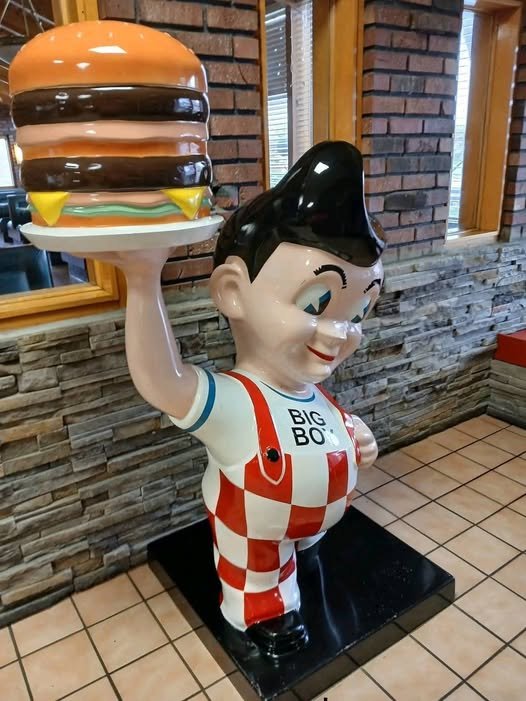
The classic Big Boy statue, the one that lives in the memories of Michigan children, is a study in cheerful exaggeration. The head is oversized, with a broad, flat face, bright blue eyes, and a smile that seems to stretch just a little too wide. The hair is a solid, sculpted wave, usually painted a glossy black. The body is stocky, dressed in a white t-shirt with a blue collar trim and the words “BIG BOY” printed across the chest in simple, bold letters. The overalls are the most striking element: a bold red-and-white checkerboard pattern that covers the legs and the bib, fastened with large, cartoonish buttons.
One arm is always raised, palm flat, supporting a plate that holds a perfectly sculpted double-decker burger. The other arm is bent at the elbow, fist clenched in a pose of quiet determination. The shoes are black, rounded, and slightly oversized. The entire figure is mounted on a dark, often rectangular base, which in some cases housed a motor that allowed the statue to rotate slowly, presenting the burger to all directions of traffic.
These statues were designed to be seen from a distance, but they were also designed to be approached. Children posed with them for photographs. Families used them as meeting points. They became, in a very real sense, public art—commercial, yes, but also communal. A Big Boy statue was a landmark. “Turn left at the Big Boy” was a perfectly valid set of directions in countless Michigan towns.
The Big Boy “Graveyards”: When Landmarks Go to Die
The passage of time is rarely kind to roadside giants. As the Big Boy chain contracted, particularly after the Elias Brothers’ bankruptcy in 2000, many restaurants closed. And when a restaurant closed, what happened to the statue? Some were sold, some were scrapped, and some, remarkably, were simply stored—parked in vacant lots, behind fences, or in remote areas, left to the elements.
This phenomenon gave rise to one of Michigan’s strangest pieces of modern folklore: the “Big Boy Graveyard.” Around 20 years ago, reports began to emerge of hikers and urban explorers stumbling upon clusters of decaying Big Boy statues, first near Marquette in the Upper Peninsula and later spreading south into Ohio. These were not carefully curated museums; they were improvised boneyards, where the cheerful faces of childhood were left to fade, peel, and crack.
The graveyards became a macabre tourist attraction for a certain kind of traveler. Photographs circulated online: rows of identical, chipped smiles; statues toppled on their sides; the bright checkered overalls faded to pastel ghosts. Some sites were gated, others were open to anyone who knew where to look. Local legends grew up around them. Some said the statues were haunted; others simply found them sad, a visual metaphor for the decline of a once-mighty brand.
It is important to note that many of these graveyards no longer exist. The statues were eventually removed, scrapped, or dispersed. The graveyard outside Negaunee, for example, is widely reported to have been cleared, with the remaining figures sent to a scrap yard. But the memory of them persists, a reminder that even the most solid-looking icons are mortal. The Big Boy graveyard is a uniquely American story: a place where commerce, nostalgia, and decay meet in a field of fiberglass smiles.
The Food: More Than Just a Burger
A mascot can only take a restaurant so far. The Big Boy experience was, at its core, about the food—and the food was a very particular kind of mid-century American comfort cuisine. The menu was extensive, designed to appeal to families, to offer something for everyone, and to keep customers coming back for more than just a quick bite.
The centerpiece was, of course, the Big Boy burger. It was a double-decker, with two thin beef patties, a three-layer bun, lettuce, American cheese, and a signature sauce that was tangy, slightly sweet, and utterly distinctive. It was a messy burger, the kind that required extra napkins and a certain amount of commitment. But it was also a burger that tasted like a treat, something different from the standard fast-food fare.
The Slim Jim and the Hot Fudge Cake
But the Big Boy menu was not just about burgers. Two other items achieved legendary status among Michigan diners. The first was the Slim Jim, a pressed sandwich made with ham, Swiss cheese, tomato, lettuce, and a special “Slim Jim sauce” on a grilled roll. The sandwich was warm, melty, and savory, with a texture that was both crispy and soft. It was the kind of sandwich that seemed simple but was difficult to replicate at home, largely because of that secret sauce.
The second was the Hot Fudge Cake. This was not a slice of cake in the traditional sense. It was a layered dessert: chocolate cake, vanilla ice cream, hot fudge, whipped cream, and a cherry on top. It was served in a glass or a bowl, and it was the kind of dessert that made a meal feel like an event. For many children, the Hot Fudge Cake was the real reason to go to Big Boy. It was the reward for finishing dinner, the centerpiece of a birthday celebration, the thing that made the long drive to the restaurant worth it.
The Salad Bar and the Family Dining Experience
Big Boy also embraced the salad bar trend, particularly in its later years. The “Fresh Market Buffet” was a fixture at many locations, offering a rotating selection of salads, soups, and desserts. The salad bar was not just about food; it was about the experience of choice, the ritual of building a plate, the sense of abundance that defined the family restaurant of the 1980s and 1990s.
The dining rooms themselves were designed for comfort and lingering. They were not fast-food outlets with hard plastic seats; they were sit-down restaurants with booths, tables, and servers. They were places where families could celebrate, where teenagers could hang out, where grandparents could take their grandchildren for a treat. The atmosphere was unpretentious, often a little dated, but always welcoming. It was the kind of place where you could order a cup of coffee and a slice of pie and feel no pressure to leave.
The Comic Book: Stan Lee and the Adventures of Big Boy
One of the most remarkable and often overlooked chapters in Big Boy history is its connection to the world of comic books. In January 1956, Big Boy restaurants began offering a comic book to children called The Adventures of Big Boy. These were not cheap, disposable pamphlets; they were professionally produced comics with stories, games, puzzles, and activities designed to entertain kids while their parents ate.
What makes this story extraordinary is the talent involved. The early issues of The Adventures of Big Boy were written and drawn by none other than Stan Lee and Bill Everett, the creative team who would later become legends at Marvel Comics. Before Spider-Man, before the Fantastic Four, before the Marvel Cinematic Universe, Stan Lee was writing stories about a cheerful boy in checkered overalls who served burgers and had wholesome adventures. The comic was produced by Timely Comics, which later became Marvel.
The comic was a massive success. It ran for 563 issues, finally ceasing publication in 1996. At its peak, it was one of the best-selling comics in America, largely because it was distributed through restaurants rather than newsstands. It was a marketing tool, yes, but it was also a genuine piece of children’s entertainment, a “non-violent mix of stories, games, puzzles, pen pals, and letters” that parents could feel good about giving to their kids.
For many Michiganders, The Adventures of Big Boy was their first comic book. It was something to read while waiting for the food to arrive, something to take home and color, something that made the restaurant feel like a place that cared about kids. The comic was a bridge between the brand and its youngest customers, a way of building loyalty that went far beyond a burger and fries.
The Cultural Imprint: Commercials, Birthdays, and Local Fame
Big Boy was not just a restaurant; it was a presence in the cultural life of Michigan. The brand invested heavily in advertising, particularly television commercials that aired during local programming and family-friendly shows. These commercials were often low-budget, cheerful, and slightly goofy, but they became part of the shared vocabulary of childhood.
One of the most famous pieces of Big Boy trivia is that a 1984 Elias Brothers Big Boy commercial featured a young Bob Saget, years before he became a household name on Full House. The commercial, which also featured Dave Coulier, was filmed in Michigan and has since become a cult artifact for fans of 1980s pop culture. It is a reminder that Big Boy was not just a place to eat; it was a platform, a part of the local entertainment ecosystem.
The restaurant also had its own rituals. The birthday song—a special, often slightly off-key tune performed by the staff—was a rite of passage for generations of children. The paper hats, the balloons, the free sundae: these were small gestures, but they mattered. They made the restaurant feel like a place that celebrated you, that was happy you were there.
The Big Boy as a Michigan Landmark
In a state defined by its automotive history, its lakes, and its changing seasons, Big Boy became an unlikely landmark. The statues were not just advertisements; they were navigational aids. “Meet me at the Big Boy” was a common phrase. The restaurant was a place where people gathered after football games, after church, after a long day at work. It was a neutral ground, a familiar face in a changing world.
This is why the closure of a Big Boy restaurant often feels like a personal loss. When the Big Boy in Mason announced it would close after almost 50 years to make way for a gas station, the community reacted with genuine sadness. When the Farmington location closed, longtime customers lamented the loss of a place where they had celebrated birthdays, first dates, and family reunions. These are not just businesses; they are the backdrops of our lives.
The Decline and the Fight for Survival
The story of Big Boy is not a straightforward narrative of endless success. Like many legacy restaurant chains, the brand faced significant challenges in the late 20th and early 21st centuries. The 1980s and 1990s saw a proliferation of new competitors, changing consumer tastes, and the rise of fast-casual dining. The family restaurant format, once dominant, began to lose ground.
The Elias Brothers, who had been such a powerful force in the brand’s expansion, filed for bankruptcy in 2000. The chain was restructured, and the remaining locations formed the Big Boy Restaurant Group. The headquarters eventually moved to Southfield, Michigan, where it remains today. The company continues to operate, but its footprint is much smaller than it once was. As of the mid-2020s, Big Boy had locations in a handful of states, with the vast majority still in Michigan.
The decline has been painful for loyalists. Many locations have closed, and the ones that remain sometimes struggle to maintain the standards that older customers remember. Reviews of some modern Big Boy restaurants are mixed, with longtime patrons noting that the food and service do not always live up to the nostalgia. The brand has also had to adapt to changing tastes, adding healthier options and updating its decor while trying to preserve the classic feel that made it special.
Yet there are signs of resilience. The Big Boy Restaurant Group has announced expansions, including new locations in Lansing, signaling a belief that the brand still has a future in its home state. The company has leaned into its heritage, promoting retro prices and classic menu items during the holidays. The statue, the mascot, and the name still carry enormous goodwill. For many Michiganders, Big Boy is not just a restaurant; it is a piece of their identity.
The Mascot’s Enduring Mystery: Who Is Big Boy?
One of the most interesting aspects of the Big Boy phenomenon is that the mascot has no fixed identity. He is not a superhero, a king, or a cartoon animal. He is simply “Big Boy,” a name that is both a title and a description. He has no origin story beyond the napkin sketch, no fictional biography beyond the comic books. He is a blank slate onto which generations of children have projected their own imaginations.
There have been attempts to flesh out his world. The comic books introduced supporting characters, including a dog named Nugget and a friend named Dolly. Dolly, a female counterpart, was introduced in the 1950s and has occasionally shared mascot duties with Big Boy. But these characters never achieved the iconic status of the Boy himself. He remains, in a sense, a mystery—a smiling, burger-bearing enigma.
This ambiguity is part of his power. Because he is not tied to a specific story or personality, he can be anything to anyone. To a child, he is a friendly giant. To a teenager, he is a place to hang out. To an adult, he is a reminder of childhood. To a community, he is a landmark. The Big Boy statue is a Rorschach test of nostalgia, and everyone sees something slightly different in that painted smile.
The Fiberglass Legacy and the Future of Roadside Americana
The Big Boy statue is part of a broader tradition of roadside architecture and commercial signage that is slowly disappearing from the American landscape. The giant fiberglass figures of the mid-20th century—the Muffler Men, the dinosaurs, the Paul Bunyans—were products of a specific moment in American car culture, when the highway was the primary stage for commercial theater. Today, those figures are increasingly rare, victims of changing zoning laws, corporate consolidation, and the simple passage of time.
The preservation of Big Boy statues has become a niche passion for collectors and roadside enthusiasts. Some statues have been restored and placed in museums; others have been purchased by private individuals and installed in their yards. The American Sign Museum, for example, has preserved an Elias Brothers rotating Big Boy, recognizing it as a significant artifact of commercial design. These efforts are important because they recognize that these statues are not just advertising; they are folk art, cultural documents, and touchstones of memory.
For Michigan, the Big Boy statue is a particularly potent symbol. It represents a time when the state was at the height of its industrial power, when the middle class was expanding, and when a family dinner at a local restaurant was a affordable luxury. The statue is a reminder of that era, but it is also a reminder that things change. The Big Boy graveyards are a stark illustration of what happens when the commerce that sustained the art disappears. But the fact that so many statues have been saved, restored, and cherished suggests that the attachment to them is deeper than mere commerce.
Conclusion: The Boy Who Never Grew Up
If you grew up in Michigan, you definitely know him. You know the statue, the smile, the burger, the commercials, the birthday song. You know the way the parking lot felt on a summer evening, the smell of fries and coffee, the sound of families talking and laughing. You know the Big Boy not as a brand, but as a presence—a fixed point in a world that has changed dramatically since the first double-decker burger was served in Glendale in 1937.
The story of Big Boy is a story about America. It is a story about immigration and entrepreneurship, about a family of Lebanese immigrants who built a restaurant empire in Detroit, about a California dream that found its most fertile soil in the Midwest. It is a story about a real boy named Richard Woodruff, whose childhood appetite became an icon. It is a story about fiberglass giants, comic books written by Stan Lee, and the strange, tender folklore of the Big Boy graveyard.
Today, Big Boy is smaller than it once was. Many of the restaurants are gone, and the ones that remain are fighting for relevance in a crowded marketplace. But the mascot endures. He stands outside the surviving locations, arm raised, burger held high, a silent promise of a hot meal and a friendly face. He is a reminder that some things are worth holding onto, even as the world moves on.
For generations of Michiganders, the Big Boy is not just a restaurant. He is a memory, a landmark, a piece of home. And as long as there is a statue by the side of the road, or a comic book in a drawer, or a hot fudge cake on a menu, that memory will never entirely fade. The Boy never grows up. He just keeps smiling, holding that burger, waiting for the next family to pull into the parking lot.
Frequently Asked Questions
Who was the real “Big Boy”?
The mascot was inspired by Richard Woodruff, a chubby six-year-old boy who hung around Bob Wian’s original hamburger stand in Glendale, California, in the 1930s. He would sweep up in exchange for free burgers, and his appearance and enthusiasm inspired both the name of the burger and the character.
When did Big Boy first come to Michigan?
The first Big Boy franchise in Michigan—and the first official franchise anywhere—was opened in 1952 by brothers John, Louis, and Fred Elias at the Dixie Drive-In in Hazel Park.
Why are there different versions of the Big Boy mascot?
Different franchise groups used slightly different designs. The Elias Brothers in Michigan used the “West Coast” design with dark hair and red-checkered overalls, while some East Coast franchises used a blonde-haired version. The two designs were eventually merged, but the dark-haired version remains the most iconic.
What happened to the Big Boy statues when restaurants closed?
Many were sold or scrapped, but some were stored in vacant lots or remote areas, creating the informal “Big Boy graveyards” that became a piece of Midwest folklore. Most of these sites have since been cleared.
Did Stan Lee really write the Big Boy comic book?
Yes. The Adventures of Big Boy was first produced by Timely Comics (later Marvel), with early issues written by Stan Lee and Bill Everett. The comic ran for 563 issues before ending in 1996.
Is Big Boy still in business?
Yes. Big Boy Restaurants is still headquartered in Southfield, Michigan, and operates a smaller number of locations, primarily in Michigan, Ohio, California, Nevada, and North Dakota.
What is the most famous menu item at Big Boy?
The iconic Big Boy burger, a double-decker with two beef patties and a three-layer bun, is the signature item. The Slim Jim sandwich and the Hot Fudge Cake are also beloved classics.
Why is the Big Boy statue so important to Michiganders?
For generations, the statue served as a landmark, a meeting place, and a symbol of family dining. It represents childhood memories, community continuity, and a specific era of American car culture and roadside hospitality.