If You’ve Ever Seen These Marks on Your Jeans, You’re Not Alone! Here’s Why They Happen
Meta Description: Noticed strange creases, “whiskers,” or baggy knees on your favorite jeans? You aren’t the only one! Discover the science behind why denim gets these marks and what they say about your fit.
Introduction
We have all been there. You pull on your favorite pair of jeans, look in the mirror (or look down at your lap), and notice strange lines, ridges, or faded patches that weren’t there when you bought them.
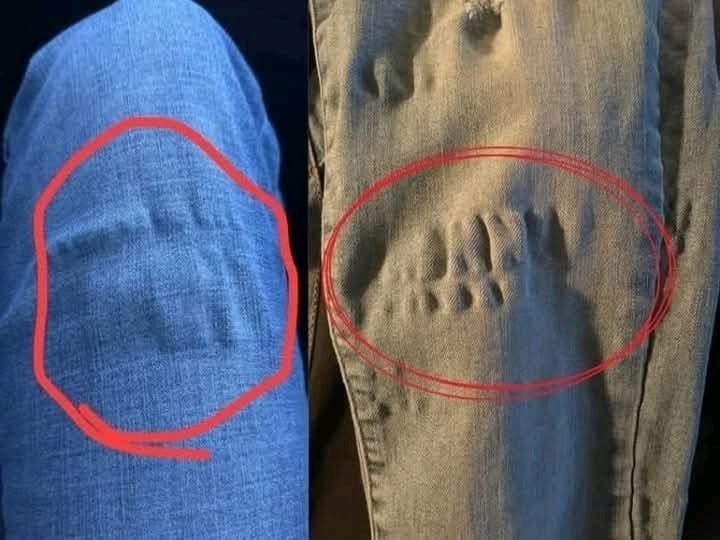
The image above highlights two of the most common “jean phenomena” that happen to almost everyone who wears denim regularly. On the left, we see horizontal ridges on the thigh/knee. On the right, we see a fan-like pattern of deep creases (often called “whiskers”) near the crotch or upper thigh.
If you have these, don’t panic! Your jeans aren’t necessarily ruined. In fact, in the world of denim, some of these marks are highly desirable. Here is the breakdown of why your jeans look like this and what causes it.
1. The “Whiskers” (The Right Image)
The pattern circled in the right image—those radiating lines that look a bit like a fan or even a handprint—is known in the denim world as “Whiskers.”
Where they appear: Usually at the crotch and upper thigh area.
Why they happen: These are permanent creases formed by the repetitive motion of your hips and legs. Every time you sit down, walk, or cross your legs, the fabric folds in the same spot. Over time, the indigo dye wears away at these high-stress points, leaving permanent white or faded lines.
The Verdict: In high-quality “raw denim,” whiskers are a badge of honor. They show the unique shape of the wearer’s body. However, in stretchy jeans, they might just indicate that the fabric is losing its elasticity.
2. The “Knee Bags” and Thigh Ridges (The Left Image)
The left image shows horizontal lines and bulging fabric, often found at the knees or thighs.
Where they appear: Front of the knees and thighs.
Why they happen: This is caused by fabric fatigue. When you bend your knee, the denim stretches. If the jeans are made of 100% cotton, they might bag out. If they contain elastane (spandex), the fibers stretch to accommodate your movement but sometimes fail to “snap back” to their original shape immediately.
The Verdict: This usually means the jeans are a bit too tight or the fabric blend has a high percentage of synthetic fibers that have worn out.
The 3 Main Reasons Your Jeans Get These Marks
1. The “Sitting” Lifestyle
Let’s be honest: we sit a lot. Whether it’s at a desk, in a car, or on the couch, sitting puts immense pressure on the denim at the hips and knees. The fabric is forced to fold and stretch repeatedly in the exact same places, creating those permanent “memory” lines.
2. The Spandex Problem
Modern jeans often contain 1-3% elastane (spandex) for comfort. While this makes them stretchy, it also makes them prone to “bagging out.”
100% Cotton: Will crease sharply (whiskers) and fade, but holds its shape better over time.
Stretch Denim: Will stretch out at the knees and crotch (bagging) and may not recover its shape after a long day of wear.
3. Washing Habits
How you wash your jeans affects these marks.
Washing too often: Can break down the fibers faster, leading to more bagging at the knees.
Washing too rarely: Allows dirt and oils to settle into the creases, making the “whiskers” fade permanently (which is great for raw denim lovers, but maybe not for those who want uniform blue jeans).
How to Fix or Prevent Them
If you hate the look of baggy knees or deep creases, here are a few tips:
Size Up: If your jeans are bagging at the knees immediately, they are likely too tight. Try a size up or a “relaxed” fit to reduce the tension on the fabric.
The “Freezer Trick”: For raw denim, some people put their jeans in the freezer to kill bacteria and “reset” the fibers without washing (though this is debated by scientists, many swear by it!).
Wash and Dry: For stretch jeans that have bagged out, a quick wash and tumble dry (on low heat) can often shrink the fibers back to their original shape temporarily.
Look for Higher Cotton Content: If you want jeans that hold their shape, look for denim with 98-99% cotton and only 1-2% elastane.
Conclusion
So, if you’ve ever seen these lines on your jeans, you’re definitely not alone! Whether it’s the “whiskers” from sitting or the “knee bags” from walking, these marks are just proof that you actually wear your clothes.
Embrace the character of your denim, or use these tips to find a pair that holds its shape better. Either way, now you know the science behind the style!