Why Men’s and Women’s Shirts Button on Opposite Sides: The Historical Reason
Meta Description: Ever notice that men’s shirts button on the right and women’s on the left? Discover the fascinating historical reasons behind this fashion rule that dates back centuries.
Introduction
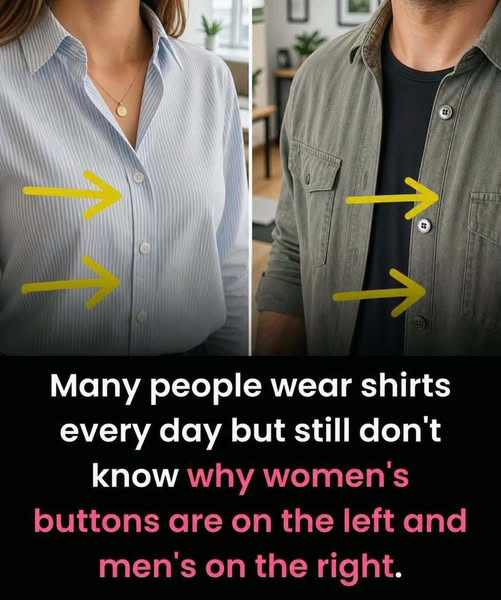
It is a detail most people overlook every single day: if you look closely at a button-down shirt, the buttons are on different sides depending on the gender of the wearer.
Men’s shirts: The buttons are on the right side (the buttonholes are on the left).
Women’s shirts: The buttons are on the left side (the buttonholes are on the right).
This isn’t a manufacturing error or a random design choice. It is a historical rule that dates back hundreds of years, rooted in how people dressed and lived in the past. Here is the factual history behind why this standard exists.
The Reason for Men: Self-Dressing and Weapons
The placement of buttons on men’s shirts is primarily driven by handedness and historical utility.
1. The Right-Handed Majority
The most practical reason is that the majority of the population is right-handed. When men dressed themselves, having the buttons on the right side made it easier for a right-handed person to manipulate the small buttons and thread them through the holes. It is simply a matter of ergonomic convenience for the dominant hand.
2. The Sword Theory
Historians also point to the era when men commonly carried weapons.
Men typically wore swords on their left hip so they could draw them quickly with their right hand.
A shirt that buttons left-over-right (buttons on the right) creates a flap that protects the chest from wind.
More importantly, if a man needed to reach across his body with his right hand to draw a sword or reach into a pocket, a left-over-right closure prevented the shirt from gaping open or the sword from snagging on the fabric.
The Reason for Women: Maids and Servants
The reason women’s buttons are on the left is entirely different and is rooted in social class and servitude.
The “Maid” Theory
In the 17th, 18th, and 19th centuries, wealthy women did not dress themselves. They had maids or ladies-in-waiting to help them into their complex, often corseted garments.
When a maid stood in front of a woman to dress her, the maid was facing the woman.
If the buttons were on the woman’s left side, they would appear on the maid’s right side.
Since most maids were right-handed, having the buttons on the right (from the maid’s perspective) made it much easier and faster for them to button the dress.
Essentially, women’s clothing was designed to be buttoned by someone else facing them, while men’s clothing was designed to be buttoned by the wearer.
The Napoleon Myth
There is a popular legend involving Napoleon Bonaparte regarding this rule. The story goes that Napoleon was frustrated by women mocking him by mimicking his famous pose (hand tucked into his jacket). To stop this, he allegedly ordered that all women’s clothing must button on the opposite side of men’s clothing to prevent them from easily copying his stance.
While this is a famous story, most fashion historians consider it a myth. The “maid theory” is the widely accepted historical explanation supported by the evolution of fashion during the Victorian era.
Why Does It Still Matter Today?
Today, very few people have maids to dress them, and swords are no longer part of daily attire. So why hasn’t the standard changed?
Tradition and Manufacturing: The fashion industry has standardized these patterns for centuries. Changing the machinery and patterns for mass production would be costly and confusing for consumers who are used to the existing layout.
Gender Signaling: In fashion, the button placement became a quick visual cue to distinguish men’s clothing from women’s clothing, especially as ready-to-wear clothing became more common in the 20th century.
Conclusion
The next time you button a shirt, remember that you are participating in a centuries-old tradition. Men’s buttons are on the right for the convenience of the right-handed wearer and historical utility, while women’s buttons are on the left as a relic of an era when wealthy women relied on right-handed maids to dress them.