Why Do Women Cross Their Legs When Sitting? (The Surprising Truth Behind the Pose)
It’s a pose seen everywhere—from boardrooms to coffee shops. But why do women cross their legs when sitting? Discover the psychological, historical, and health reasons behind this common habit.
Introduction
Walk into any waiting room, office, or café, and you will likely see it: a woman sitting with one leg elegantly crossed over the other. It is a universal posture, so common that we rarely stop to think about why we do it.
Is it just a habit? Is it for comfort? Or is there a deeper psychological or historical reason?
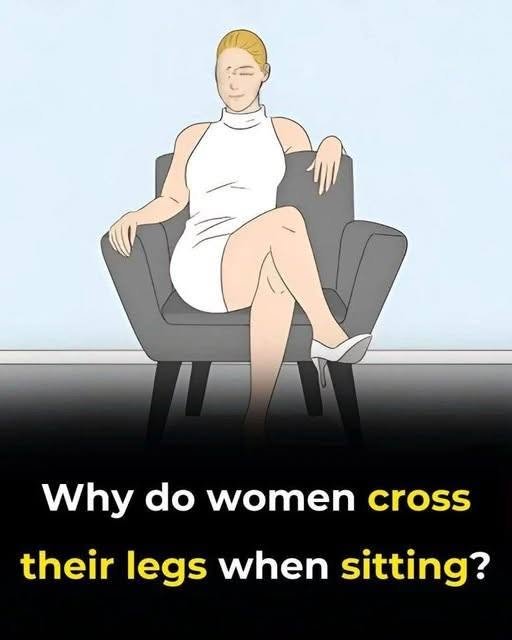
As the image above asks, “Why do women cross their legs when sitting?” The answer is a fascinating mix of social etiquette, anatomy, and body language. Here is the breakdown of why this pose is so popular—and why doctors might actually want you to stop doing it.
1. The Historical Reason: Modesty and Etiquette
For centuries, the primary reason women crossed their legs was simple: clothing.
Before pants became a standard part of the female wardrobe, women wore skirts and dresses. Sitting with legs apart (often called “manspreading” when men do it) would be considered immodest or “unladylike” because it risked exposing undergarments.
The “Ladylike” Standard: Crossing legs at the knee or the ankle became the standard for “proper” feminine posture. It was a way to maintain modesty while sitting.
The Habit Remains: Even though most women now wear pants, jeans, or shorts, the muscle memory of “sitting like a lady” has been passed down through generations. It is deeply ingrained in our social conditioning.
2. The Anatomical Reason: Pelvic Structure
Believe it or not, biology plays a role. Women generally have a wider pelvis than men to accommodate childbirth. This wider pelvic structure changes the angle of the femur (thigh bone).
The “Q-Angle”: Because of the wider hips, the femur angles inward toward the knee. For some women, crossing the legs actually feels more mechanically stable and comfortable than sitting with knees wide apart, which can feel like a stretch on the hip joints.
3. The Psychological Reason: Body Language
In the world of psychology and non-verbal communication, crossing your legs sends a specific signal.
The “Closed” Position: Crossing legs (especially tightly) is often a sign of being “closed off.” It can indicate that a person is feeling defensive, shy, or resistant to the conversation. It creates a physical barrier between the person and the world.
The “Comfort” Position: Conversely, if a woman is leaning back in a chair (like the woman in the illustration) with legs crossed loosely, it signals relaxation and confidence. She feels secure enough in her environment to take up a specific, balanced pose.
4. The Health Warning: Why You Should Stop!
While the pose looks elegant, medical professionals generally advise against sitting with crossed legs for long periods. Here is why:
Blood Pressure Spikes: Studies show that crossing your legs at the knee temporarily increases blood pressure. The blood has to work harder against gravity to get back to the heart.
Posture Problems: Crossing your legs tilts your pelvis. Over time, this can lead to lower back pain and misalignment of the spine.
Varicose Veins: While it doesn’t cause varicose veins, crossing legs restricts blood flow in the veins that are already struggling against gravity, which can make existing vein issues worse.
The Verdict: Comfort vs. Convention
So, why do women cross their legs?
It started as a necessity for modesty in an era of skirts and dresses. It evolved into a social norm of “politeness.” And for many, it simply feels like a comfortable way to rest the hips.
However, if you find yourself doing it for hours at a desk, it might be time to uncross. Your back (and your blood pressure) will thank you!