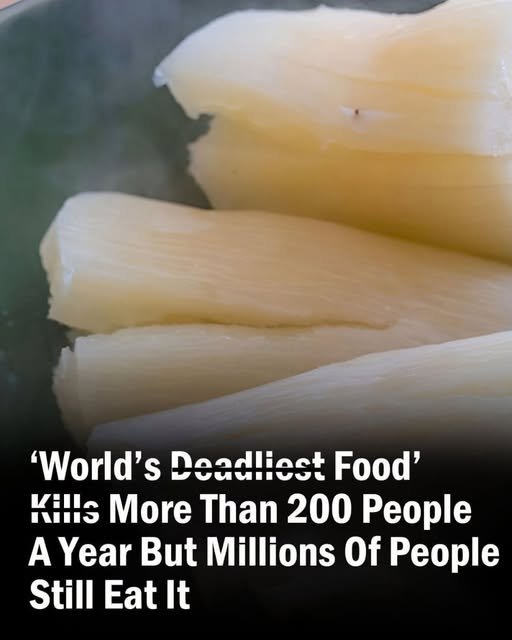
The image above presents a stark and alarming claim: a food that kills more than 200 people a year is still eaten by millions. This is not a piece of internet fiction. The food in question is cassava, a starchy root vegetable also known as yuca or manioc. It is a dietary staple for an estimated 500 to 800 million people across the tropics, yet it contains naturally occurring toxins that can be fatal if the root is not prepared correctly.
Understanding how a food can be both a vital lifeline and a potential hazard requires looking at the science of its toxicity, the cultural knowledge that makes it safe, and the circumstances under which it becomes dangerous.
What Is Cassava and Why Is It So Important?
Cassava is a woody shrub native to South America, though Nigeria is currently the world’s largest producer. It is a remarkably resilient crop. It can grow in poor soils, withstand drought, and produce a high yield of calorie-dense roots. For subsistence farmers in tropical regions, these qualities make cassava an indispensable source of food security.
However, this resilience comes with a hidden cost. The cassava plant has evolved a chemical defense mechanism against pests and herbivores. Its roots, skin, and leaves contain compounds called cyanogenic glycosides, primarily linamarin and lotaustralin. When the plant’s cells are damaged—through peeling, cutting, or grating—an enzyme called linamarase is released, which breaks down these compounds to produce hydrogen cyanide, a potent and fast-acting poison.
The Spectrum of Toxicity: Sweet vs. Bitter Cassava
Not all cassava is equally dangerous. There are two main categories, often referred to as “sweet” and “bitter” varieties.
Sweet Cassava: These varieties have low levels of cyanogenic compounds. A kilogram of sweet cassava may contain around 20 milligrams of cyanide. Sweet cassava can often be peeled and cooked with relatively little risk.
Bitter Cassava: These varieties produce much higher levels of toxins, with some containing up to 1,000 milligrams of cyanide per kilogram. Bitter cassava is often preferred by farmers in challenging environments because its toxicity deters pests and animals, offering a more reliable harvest. However, it requires extensive processing to be made safe for human consumption.
The Health Consequences of Improper Preparation
When cassava is eaten raw or is insufficiently processed, the cyanide it releases can cause serious harm.
Acute Cyanide Poisoning Consuming a large dose of unprocessed cassava can lead to acute cyanide poisoning. Symptoms can appear rapidly and include dizziness, headache, nausea, vomiting, abdominal pain, and mental confusion. In severe cases, it can cause respiratory failure, convulsions, and death. The World Health Organization estimates that cassava poisoning is responsible for approximately 200 deaths per year.
Konzo: A Permanent Neurological Disorder Perhaps the most devastating consequence of chronic, low-level cyanide exposure from cassava is a condition called konzo. Konzo is an irreversible neurological disease characterized by a sudden onset of spastic paraparesis—a permanent stiffness and weakness in the legs. It leads to a distinctive, jerky walking gait and can eventually confine individuals to wheelchairs or crutches.
Konzo primarily affects children and women of childbearing age in poor, rural communities in sub-Saharan Africa. It occurs when people rely almost exclusively on bitter cassava for calories and do not have the time, water, or resources to process it properly. The disease is not infectious, and patients do not suffer cognitive decline from konzo itself, but the physical disability can have profound social and economic consequences.
The Knowledge That Makes Cassava Safe
The reason hundreds of millions of people can eat cassava without harm is that traditional food processing methods are remarkably effective at removing the toxins. These methods are not modern inventions; they are generations-old practices passed down through cultures.
The key to detoxification is giving the enzyme time to release the cyanide and then providing a way for the gas to escape or dissolve. Common methods include:
Soaking: The roots are peeled and submerged in water for several days—often three days and nights, or longer if the water is cold. The cyanide dissolves into the water.
Fermentation: The grated or soaked pulp is left to ferment. This process, used to make products like gari and fufu, allows microorganisms to break down the cyanogenic compounds. Fermentation can remove over 90% of the toxins.
Drying: Sun-drying or drying the flour in thin layers in the shade allows the hydrogen cyanide gas to dissipate into the air.
Cooking: Boiling the roots or the processed flour provides the final layer of safety, driving off any remaining cyanide.
When these steps are followed correctly, the final product is safe and nutritious. However, the danger arises when these steps are rushed or skipped, often during times of food shortage or famine.
What You Should Know If You Eat Cassava
For consumers in regions where cassava is widely available, the risk is generally low, provided the food is purchased from reputable sources or prepared according to traditional methods. However, awareness is important.
Never eat raw cassava. Always peel and cook it thoroughly.
Be cautious with bitter varieties. If you are preparing bitter cassava at home, follow traditional detoxification recipes meticulously. Do not shorten the soaking or fermentation times.
Purchase processed cassava products from reliable suppliers. Commercially produced cassava flour and other products are typically processed to reduce cyanide levels to safe standards.
Recognize the symptoms. If you experience dizziness, headache, or nausea after eating cassava, seek medical attention immediately.
Frequently Asked Questions
Q: Is all cassava poisonous? All cassava contains some level of cyanogenic compounds, but the amount varies widely. Sweet varieties have low levels and are safe after basic cooking. Bitter varieties have high levels and require extensive processing to be safe.
Q: Can you get cyanide poisoning from eating cassava? Yes, if the cassava is raw or improperly processed. Consuming large amounts of unprocessed bitter cassava can cause acute cyanide poisoning, which can be fatal.
Q: What is konzo? Konzo is an irreversible neurological condition caused by chronic consumption of insufficiently processed bitter cassava. It causes permanent stiffness and weakness in the legs, leading to difficulty walking.
Q: How do people make cassava safe to eat? Traditional methods like soaking in water for several days, fermentation, sun-drying, and thorough cooking allow the toxic cyanide compounds to be removed or broken down.
Q: Is cassava still a good food to eat? For hundreds of millions of people, cassava is an essential source of calories and nutrition. When prepared correctly, it is a safe and valuable food. The key is proper processing and traditional knowledge.
Conclusion
The label of “world’s deadliest food” is a dramatic oversimplification, but it points to a real and complex reality. Cassava is not inherently evil; it is a plant with a powerful natural defense mechanism. The 200 deaths a year attributed to cassava poisoning are not the result of the food itself, but of poverty, food insecurity, and the circumstances that force people to skip the crucial steps that make it safe. For the vast majority of the half-billion people who depend on it, cassava is a safe, life-sustaining staple. The story of cassava is a testament to human ingenuity—our ability to transform a toxic root into a nourishing food—and a reminder of the importance of preserving and sharing that knowledge.