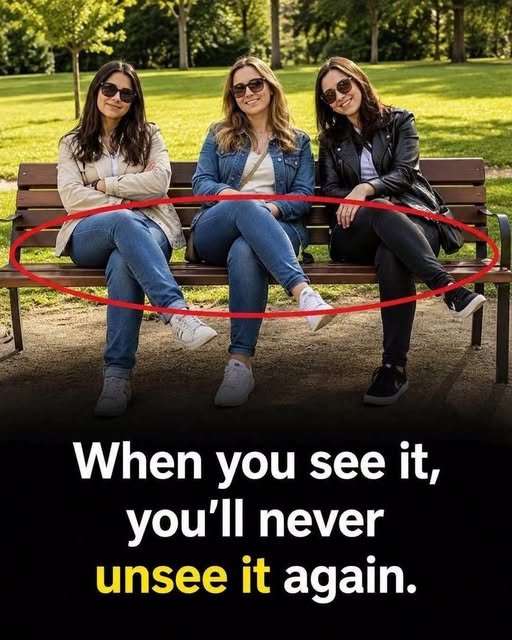
The “Floating Women on a Bench” Illusion: Why Your Brain Falls for the “Never Unsee” Trick
Every few months, the internet becomes captivated by a single image that seems to defy the laws of physics. In 2016, a seemingly ordinary photograph of three women relaxing on a park bench achieved viral status, not for who was in the picture, but for what was missing. The image, which was originally shared on Imgur and Reddit before being picked up by major news outlets, shows three friends sitting side-by-side in a sunlit park. At first glance, it is a perfectly mundane scene of a leisurely afternoon. But a closer inspection reveals a visual impossibility: the women appear to be floating in mid-air, with no visible seat supporting them beneath their crossed legs.
The caption accompanying the image was a challenge: “When you see it, you’ll never unsee it again.” This phrase has become a staple of internet culture, a promise that once a hidden detail is revealed, your perception of the image will be permanently altered. And indeed, for thousands of people who stared at the photograph in confusion, the realization is sudden and jarring. The mind struggles to reconcile what it knows should be there—a solid wooden or metal plank—with what it actually sees: empty space. This visual puzzle is more than just a passing viral fad. It is a fascinating window into the mechanics of human perception, the limits of our visual system, and the psychological power of the “never unsee” phenomenon.
This article explores the anatomy of this viral illusion, examining the possible explanations behind the floating women, the cognitive science that makes such tricks so effective, and the broader cultural landscape of “unseeable” images. By understanding why our brains are so easily fooled, we can appreciate the delicate and often fragile process by which we construct our reality from the raw data of our senses.
The Anatomy of a Viral Illusion: What Exactly Are We Looking At?
To understand the illusion, one must first appreciate the visual composition of the photograph. The image features three women sitting on a wooden park bench. The woman on the left wears a light-colored jacket and blue jeans, her legs crossed. The woman in the middle, in a denim jacket, also has her legs crossed. The woman on the right, in a dark jacket and black pants, mirrors this posture. The background is a lush, green park with trees and grass, suggesting a warm, pleasant day.
The Missing Seat
The central puzzle lies in the bench itself. If you look at the space directly beneath the women’s thighs and buttocks, you will notice that the horizontal slats that should form the seat of the bench are absent. Instead, the space between the front edge of the bench and the backrest appears empty. The women’s legs hang down, and their feet are planted on the ground, but the crucial supporting structure is invisible. This creates the immediate, unsettling impression that they are hovering in a seated position, held up by nothing but the sheer force of core strength.
The red circle often superimposed on viral versions of this image draws immediate attention to this region, guiding the viewer’s eye to the exact point of contradiction. The visual system, having identified the subject as “people sitting on a bench,” expects to see a seat. When that expectation is violated, the brain momentarily short-circuits, trying to find an alternative explanation. The result is a cognitive dissonance that is both confusing and compelling.
The Role of Expectation and Context
The illusion works so well because the human brain is a prediction machine. It does not process every pixel of an image from scratch; instead, it relies on prior knowledge and context to fill in the gaps. When we see three people in a seated posture on a park bench, our brains automatically infer the presence of a seat, even if it is not explicitly visible. The visual system is designed to prioritize the detection of meaningful patterns over the accurate recording of every detail. In this case, the expectation of a seat is so strong that it temporarily overrides the contradictory visual evidence. This is a classic example of top-down processing, where our expectations and beliefs shape what we perceive.
Unraveling the Mystery: Photoshop, Pull-Out Seats, or Visual Trickery?
The question that inevitably follows the realization of the illusion is: how was it done? There are several competing explanations, each with varying degrees of plausibility. The original image is widely believed to be a digital manipulation, but the possibility of a clever physical setup cannot be entirely ruled out.
The Photoshop Hypothesis
The most straightforward and widely accepted explanation is that the image was digitally altered. In the era of easily accessible photo-editing software, removing the seat of a bench is a relatively simple task. The texture of the background grass and the bench’s wooden frame can be seamlessly cloned to cover the area where the seat should be. This hypothesis is supported by the fact that the image first circulated on platforms like Imgur and Reddit, which are hubs for creative image manipulation and Photoshop battles. The viral nature of the image, with its perfect balance of mundane setting and impossible physics, is characteristic of a well-executed digital prank designed specifically to baffle and engage viewers.
The Pull-Out Seat Theory
An alternative explanation, proposed by some observers, suggests that the bench may have individual, smaller pull-out seats that are not easily visible when the women are sitting on them. According to this theory, the bench is not a standard continuous-seat model but a specialized design where each person sits on a separate, narrower support that retracts or blends into the frame. While this is a plausible physical explanation, it is less likely than digital manipulation. Park benches of this specific design are relatively uncommon, and the visual result—the complete absence of any visible horizontal support—would require the seats to be exceptionally well-hidden or extremely narrow. Moreover, the women’s postures, leaning back slightly against the backrest, would require the seats to be positioned in a very specific way to maintain balance without being seen.
The Perspective and Posture Hypothesis
A third, more speculative explanation involves the women’s posture and the camera angle. It is theoretically possible that the women are not sitting at all, but rather leaning back against the backrest of the bench while supporting their weight with their legs, creating the illusion of sitting. This would require significant core strength and balance, which is why it is often mentioned humorously in discussions of the image. However, this hypothesis struggles to account for the relaxed, comfortable appearance of the women. Their body language suggests genuine relaxation, not the tense exertion required for such a feat.
Ultimately, the most parsimonious explanation remains digital manipulation. The image is a carefully constructed puzzle, designed to exploit the brain’s reliance on context and expectation. Whether it was created for a Photoshop contest or simply as a prank, it has succeeded in its goal: to make millions of people question what their eyes are telling them.
The Neuroscience of “Never Unsee”: How Perception Becomes Permanent
The phrase “never unsee” captures a profound truth about human consciousness. Once a perceptual pattern is recognized, it becomes incredibly difficult to reverse. The brain is fundamentally a learning machine, and when it discovers a new way of interpreting sensory data, it updates its internal model of the world. This is why, after you finally spot the missing seat, you cannot go back to seeing the image as a normal photograph. The illusion is broken, and the knowledge of the trick permanently alters your perception.
The Role of Predictive Processing
Modern neuroscience increasingly views the brain as a prediction engine. Rather than passively receiving information from the senses, the brain actively generates hypotheses about what is out there and uses sensory input to correct its predictions. In the case of the bench illusion, the brain’s initial prediction—that people sitting on a bench are supported by a seat—is strong enough to override the visual evidence for a brief period. When the discrepancy is finally noticed, the brain updates its model. The new model, which includes the absence of a seat, becomes the dominant interpretation. The old interpretation is suppressed, and the viewer is left with a sense of having been “fooled.”
This process is similar to what happens with ambiguous figures, such as the famous Rubin vase or the Necker cube. Once you see both interpretations, you can switch between them voluntarily, but you cannot un-know that the alternative exists. The “never unsee” effect is a testament to the plasticity of the brain and its ability to rapidly incorporate new information into its perceptual framework.
The Eureka Moment and Cognitive Reward
There is also a psychological reward associated with solving a visual puzzle. The moment of realization—the “eureka” moment—is often accompanied by a rush of satisfaction and amusement. This positive reinforcement encourages people to share the image with others, perpetuating the viral cycle. The challenge of the puzzle, combined with the promise of a hidden truth, creates a compelling incentive for engagement. When the secret is finally revealed, the viewer feels a sense of accomplishment, even if the accomplishment is trivial. This emotional payoff is a key ingredient in the success of viral optical illusions.
The Cultural Phenomenon of the “Unseeable” Image
The floating women on the bench are part of a long and rich tradition of visual puzzles that have captivated the public imagination. The internet has accelerated the spread of these images, allowing them to reach millions of people in a matter of hours. The “never unsee” genre has become a staple of social media, with countless examples of images that contain hidden details, impossible objects, or confusing perspectives.
The Dress and the Limits of Perception
Perhaps the most famous example of a viral perceptual puzzle is “The Dress.” In 2015, a photograph of a dress sparked a global debate over whether it was blue and black or white and gold. The image was an optical illusion caused by the way the brain interprets the color of the dress in the context of the surrounding lighting. The debate highlighted the fact that perception is not a direct recording of reality but an interpretation constructed by the brain. Different people, with different visual systems and prior experiences, can perceive the same image in fundamentally different ways. The dress phenomenon demonstrated that even something as seemingly objective as color can be subject to ambiguity and disagreement.
The Yanny/Laurel Auditory Illusion
The “never unsee” phenomenon is not limited to vision. In 2018, an audio clip went viral because some people heard the word “Yanny” while others heard “Laurel.” The illusion was caused by the ambiguity of the acoustic signal, which contained frequencies that could be interpreted in two different ways. The brain’s auditory system, like its visual system, relies on prior expectations and context to make sense of ambiguous input. The Yanny/Laurel debate was a powerful reminder that perception is an active, constructive process that can vary from person to person.
The Hidden Image Puzzles
Another popular category of “unseeable” images involves hidden pictures or camouflaged objects. These puzzles challenge the viewer to find a concealed shape or figure within a complex scene. The thrill of discovery, followed by the inability to forget the hidden image, is the same mechanism at play in the bench illusion. These puzzles are often used in psychological research to study visual search, attention, and the role of top-down processing in perception.
Why Do We Love to Be Fooled?
The enduring popularity of optical illusions raises an interesting question: why do we enjoy being tricked? The answer lies in the nature of human curiosity and the pleasure of problem-solving. Optical illusions offer a safe, low-stakes opportunity to experience a violation of expectations. They challenge our assumptions about the world and remind us that our senses are not infallible.
The Social Dimension of Sharing
Sharing an optical illusion is a social act. It is a way of saying, “Look at this—it fooled me, and it will probably fool you too.” The shared experience of confusion and eventual enlightenment creates a sense of connection and communal discovery. Social media platforms thrive on this kind of content because it is highly engaging and encourages interaction. The comment sections of viral illusion posts are often filled with people expressing disbelief, offering explanations, and sharing their own “aha” moments.
The Appeal of the Counterintuitive
Humans are naturally drawn to things that defy expectations. The floating women on the bench are compelling because they violate a fundamental law of physics: objects cannot float unsupported. The brain is forced to confront a contradiction, and the resolution of that contradiction is inherently satisfying. This is the same appeal that draws people to magic tricks, riddles, and science fiction. We enjoy having our mental models challenged, as long as the challenge is ultimately resolvable.
The Broader Implications: Perception, Reality, and Trust
The bench illusion, while entertaining, also carries deeper implications about the nature of perception and reality. It serves as a reminder that what we see is not a direct reflection of the world, but a constructed representation. Our brains are constantly making inferences, filling in gaps, and prioritizing certain information over others. This process is usually highly effective, allowing us to navigate the world quickly and efficiently. But it also makes us vulnerable to manipulation and deception.
The Fallibility of Eyewitness Testimony
The lessons of optical illusions extend beyond the realm of internet puzzles. In the real world, the fallibility of human perception has serious consequences. Eyewitness testimony, for example, is notoriously unreliable. Studies have shown that memory and perception can be easily distorted by stress, suggestion, and post-event information. The bench illusion is a dramatic demonstration of how the brain can confidently perceive something that is not there. It underscores the importance of skepticism and critical thinking when evaluating sensory evidence.
The Importance of Looking Closer
The viral caption, “When you see it, you’ll never unsee it again,” is an invitation to look closer. It encourages viewers to move beyond a superficial glance and to engage with the image in a more deliberate way. In a world of constant information overload, the ability to pause, scrutinize, and question our initial impressions is more valuable than ever. The bench illusion is a playful reminder that reality is often more complex than it first appears.
Conclusion: The Permanent Shift in Perception
The image of the three women floating on a park bench is a masterclass in visual deception. It exploits the brain’s innate tendency to rely on context and expectation, creating a temporary blind spot that, once recognized, can never be ignored. Whether the result of skillful Photoshop editing, a clever physical setup, or a fortunate camera angle, the illusion has earned its place in the pantheon of viral internet puzzles.
But beyond the momentary confusion and amusement, the “never unsee” phenomenon offers a valuable insight into the workings of the human mind. It reveals that perception is not a passive reception of data but an active, constructive process. Our brains are constantly interpreting, predicting, and filling in the blanks. This process is usually seamless, but when it goes wrong—or when it is deliberately tricked—the results can be startling. The bench illusion is a reminder that our senses are not infallible, and that reality is often a matter of interpretation. Once you have seen the missing seat, you have not just learned a fact about a photograph; you have gained a deeper appreciation for the remarkable, and sometimes fragile, nature of human perception. And that is a lesson you will never unsee.
Frequently Asked Questions
What is the “floating women on a bench” optical illusion?
The illusion is a viral photograph showing three women sitting on a park bench. On closer inspection, the seat of the bench appears to be missing, making it look as though the women are hovering in mid-air. The image is designed to exploit the brain’s expectation of a solid seat, creating a confusing and memorable visual puzzle.
Is the image real or Photoshopped?
The most widely accepted explanation is that the image was digitally altered. It is relatively simple to remove the seat of a bench using photo-editing software. While some have theorized that the bench might have hidden pull-out seats, the consensus among online observers is that the image is a clever digital manipulation.
Why can’t I unsee the missing seat after I notice it?
The “never unsee” effect occurs because the brain updates its perceptual model once it discovers the trick. Before you notice the missing seat, your brain relies on the expectation of a normal bench. After you see the anomaly, that new information becomes part of your interpretation, and you can no longer revert to the original, naive perception.
What does this illusion reveal about human perception?
It demonstrates that perception is an active, constructive process. The brain uses prior knowledge and context to make sense of sensory input, often filling in gaps. This makes perception efficient but also vulnerable to errors and manipulation. The illusion is a powerful example of top-down processing, where expectations shape what we see.
Are there other famous “never unsee” images?
Yes. “The Dress” (which appeared blue and black to some and white and gold to others) and the Yanny/Laurel audio clip are two of the most famous examples of viral perceptual ambiguities. Like the bench illusion, they highlight the subjective and interpretive nature of human perception.
Why do people enjoy sharing optical illusions?
Sharing an optical illusion is a social activity that combines the pleasure of problem-solving with the desire to connect with others. The shared experience of confusion and discovery is engaging, and the “aha” moment provides a sense of satisfaction that people are eager to pass on.
Can optical illusions tell us anything useful about the brain?
Absolutely. Optical illusions are valuable tools in neuroscience and psychology. They help researchers understand how the visual system processes information, how the brain resolves ambiguity, and how prior knowledge influences perception. They also illustrate the limits of human attention and the fallibility of eyewitness testimony.