5 Symptoms of a Mini Stroke in Seniors That Shouldn’t Be Ignored
Think a “mini-stroke” isn’t a big deal? Think again. Discover the 5 early warning signs of a Transient Ischemic Attack (TIA) in older adults and why immediate action is crucial.
Introduction
We often hear the term “mini-stroke” and assume it’s a minor inconvenience—like a papercut compared to a deep wound. But in the medical world, a “mini-stroke,” officially known as a Transient Ischemic Attack (TIA), is anything but minor.
In fact, it is a critical warning siren from your body.
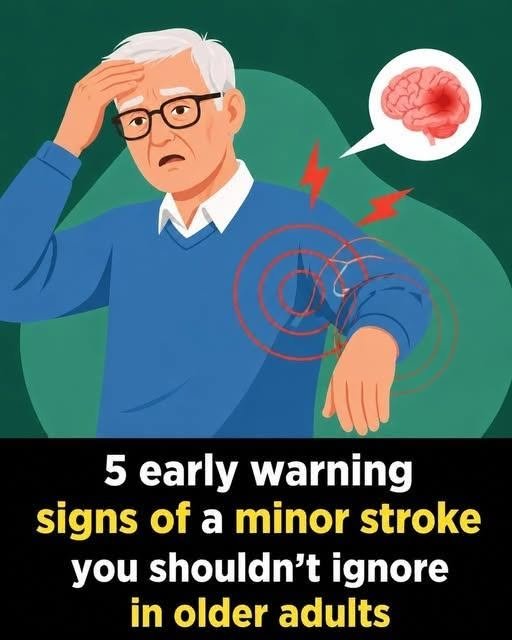
As the image above illustrates, the signs can be subtle but distressing: sudden confusion, weakness in the arm, or a severe headache. For older adults, recognizing these symptoms can be the difference between a full recovery and a life-altering major stroke.
Here are the 5 early warning signs of a mini-stroke that you and your loved ones must never ignore.
1. Sudden Numbness or Weakness (Especially on One Side)
The most classic sign of a TIA is a sudden loss of strength or sensation.
What to look for: You might notice that one arm feels heavy or “asleep” (as shown by the red target circles on the man’s arm in the image).
The Test: Ask the person to raise both arms. If one arm drifts downward involuntarily, or if they cannot lift it at all, this is a major red flag. This can also happen in the face (causing a droop) or the leg.
2. Confusion and Trouble Speaking
A mini-stroke affects the brain’s blood supply, which can instantly scramble your ability to communicate.
What to look for: The person might suddenly be unable to find the right words, speak in gibberish, or slur their speech as if they are intoxicated.
The Test: Ask them to repeat a simple sentence like “The sky is blue.” If they cannot do it, or if their speech is slurred, call for help.
3. Vision Changes in One or Both Eyes
Because the eyes are directly connected to the brain, a blockage in blood flow can cause immediate visual disturbances.
What to look for: This isn’t just “needing glasses.” It is often described as a curtain falling over one eye, sudden blurriness, or seeing double.
The Warning: If an older adult suddenly complains that they “can’t see out of the left eye,” do not assume it’s just a migraine.
4. Dizziness and Loss of Balance
The image shows the man holding his head, looking distressed. This often accompanies a sudden sense of vertigo.
What to look for: A sudden feeling that the room is spinning, unsteadiness when walking, or a complete loss of coordination.
The Risk: This is dangerous for seniors as it frequently leads to falls. If a senior suddenly becomes clumsy or cannot walk in a straight line, investigate further.
5. A Severe, Unexplained Headache
While less common than weakness, a sudden headache can be a sign of a hemorrhagic TIA (bleeding in the brain) or a blockage.
What to look for: A headache that comes on very quickly and is described as “the worst headache of my life,” or a headache accompanied by vomiting or altered consciousness.
Why “Mini” is a Dangerous Word
The term “mini-stroke” is dangerous because the symptoms of a TIA often disappear within minutes or hours. The person might feel fine the next morning and decide not to go to the doctor.
This is a fatal mistake.
A TIA is a warning shot. It means a blood clot temporarily blocked an artery, but the body dissolved it before permanent damage occurred. However, the underlying cause (high blood pressure, cholesterol, plaque buildup) is still there.
Statistics show that about 1 in 3 people who have a TIA will eventually have a stroke, with about half occurring within a year of the TIA.
The F.A.S.T. Test: What To Do
If you suspect a mini-stroke, do not wait to see if it passes. Use the F.A.S.T. test:
F (Face): Ask them to smile. Does one side droop?
A (Arms): Ask them to raise both arms. Does one drift down?
S (Speech): Is their speech slurred or strange?
T (Time): If you see any of these signs, it is Time to call 911 immediately.
Conclusion
A mini-stroke is your body’s final warning before a major event. By recognizing the signs—numbness, speech issues, vision loss, dizziness, and severe headaches—you can get the medical intervention needed to prevent a tragedy.
Don’t ignore the warning signs. Share this post with your older loved ones today.
Disclaimer: This article is for informational purposes only and does not constitute medical advice. If you suspect you or someone else is having a stroke or TIA, call emergency services immediately.