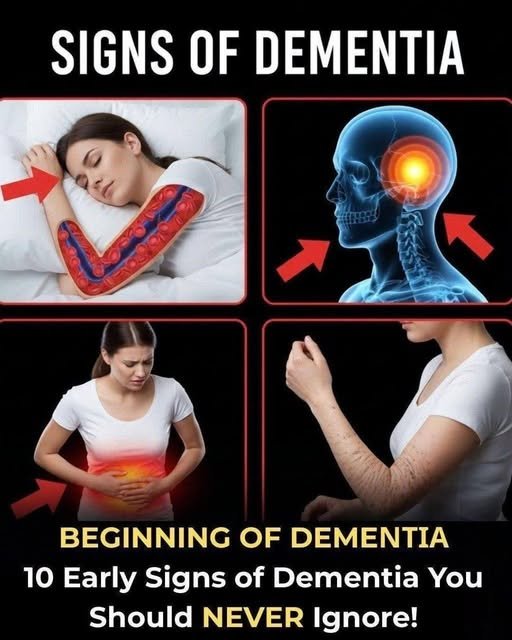
In the age of social media, health information is often distilled into bite-sized, highly visual graphics designed to capture attention. A recent viral image making the rounds claims to reveal the “Beginning of Dementia” and the “10 Early Signs of Dementia You Should NEVER Ignore.”
The graphic features four distinct visual panels: a woman sleeping with her arm highlighted in red and blue veins, a skeletal head with a glowing spot in the brain and neck, a woman experiencing stomach pain, and an arm with a dotted rash or marks. While the design is certainly eye-catching, the information it presents is deeply misleading.
Dementia is a complex, progressive neurodegenerative syndrome, not a sudden physical ailment characterized by localized pain, rashes, or a glowing neck. By suggesting that a stomach ache, a skin rash, or a sore arm are early signs of dementia, the image creates unnecessary panic and distracts from the genuine, well-established cognitive warning signs of the disease.
Understanding the true nature of dementia, differentiating it from normal aging, and recognizing the actual clinical signs are essential for seeking timely medical care. This article will deconstruct the misinformation in the viral image, explore the real early symptoms of dementia, and provide a comprehensive guide for patients and families navigating this challenging condition.
Why the Viral Image is Misleading
The fundamental flaw in the viral post is the confusion between a neurodegenerative brain disease and general bodily discomfort.
Dementia is an umbrella term for a decline in mental ability severe enough to interfere with daily life. It is primarily a cognitive disorder. The most common cause is Alzheimer’s disease, followed by vascular dementia, Lewy body dementia, and frontotemporal dementia.
Here is why the specific panels in the image are incorrect as early signs of dementia:
Arm Pain and Veins (Top Left): The image shows a sleeping woman with a highlighted arm. While poor circulation or nerve compression (like a pinched nerve) can cause arm pain, it is not a sign of early dementia.
Glowing Brain/Neck (Top Right): This is a purely illustrative graphic meant to represent the brain. However, early dementia does not cause localized pain in the neck or a “glowing” sensation in the head.
Stomach Pain (Bottom Left): Gastrointestinal issues, indigestion, or abdominal pain are completely unrelated to the early stages of dementia.
Skin Rash/Marks (Bottom Right): A rash, skin infection, or allergic reaction has no clinical relationship with the onset of dementia.
Posts like this often use unrelated, eye-catching physical symptoms as clickbait to drive traffic or engagement. They exploit the widespread fear of cognitive decline to spread misinformation.
The Real Early Signs: What Actually Changes in the Brain
The true early signs of dementia are cognitive, behavioral, and psychological. The Alzheimer’s Association and medical professionals worldwide have established a standard set of 10 warning signs that indicate a brain might be experiencing abnormal changes.
It is important to note that occasional forgetfulness is a normal part of aging. The key difference between normal aging and dementia is the impact on daily life and independence.
1. Memory Loss That Disrupts Daily Life
This is the most common early symptom. Forgetting the name of an acquaintance is normal; forgetting the name of a close family member or repeating the same question over and over again in a short span is not. People with early dementia may forget recently learned information, important dates, or events, and rely heavily on memory aids or family members to handle things they used to manage independently.
2. Challenges in Planning or Solving Problems
A person might experience changes in their ability to develop and follow a plan or work with numbers. For example, they might struggle to follow a familiar recipe, keep track of monthly bills, or manage a budget. They might take much longer to complete tasks than they did in the past.
3. Difficulty Completing Familiar Tasks
People with dementia often find it hard to complete daily tasks. They may forget how to drive to a familiar location, manage a budget, or remember the rules of a favorite game. They might need help setting up a television recording or using a microwave.
4. Confusion with Time or Place
Losing track of dates, seasons, and the passage of time is a common sign. A person might forget where they are or how they got there. This is distinctly different from temporarily forgetting what day of the week it is and figuring it out later.
5. Trouble Understanding Visual Images and Spatial Relationships
For some people, vision problems are a sign of Alzheimer’s. They may have difficulty reading, judging distance, and determining color or contrast. In terms of perception, they may pass a mirror and think someone else is in the room.
6. New Problems with Words in Speaking or Writing
A person might struggle to follow or join a conversation. They may stop in the middle of a sentence and have no idea how to continue, or they might repeat themselves. They might struggle to find the right word (e.g., calling a “watch” a “hand-clock”).
7. Misplacing Things and Losing the Ability to Retrace Steps
A person with dementia may put things in unusual places. They may lose things and be unable to go back over their steps to find them again. Sometimes, they may accuse others of stealing, especially as the disease progresses.
8. Decreased or Poor Judgment
They may experience changes in judgment or decision-making. For example, they may use poor judgment when dealing with money, giving large amounts to telemarketers. They may also pay less attention to grooming or keeping themselves clean.
9. Withdrawal from Work or Social Activities
A person may start to remove themselves from hobbies, social activities, work projects, or sports. They may avoid being social because of the changes they have experienced, feeling overwhelmed or embarrassed.
10. Changes in Mood and Personality
The mood and personalities of people with dementia can change. They can become confused, suspicious, depressed, fearful, or anxious. They may be easily upset at home, at work, with friends, or in places where they are out of their comfort zone.
The Intersection of Physical Health and Dementia
While the viral image’s physical symptoms are wrong, it is true that physical health and cognitive health are deeply connected. The confusion often arises from conditions like Vascular Dementia, which is the second most common cause of dementia.
Vascular dementia is caused by conditions that block or reduce blood flow to various regions of the brain, depriving them of oxygen and nutrients. This can occur after a stroke or a series of mini-strokes (TIAs).
In vascular dementia, the physical issues (like high blood pressure, high cholesterol, or heart disease) are risk factors for the cognitive decline. However, the early signs of vascular dementia are still primarily cognitive—such as sudden confusion, trouble paying attention, or difficulty with problem-solving—not a localized rash or stomach pain.
Furthermore, it is crucial to remember that as dementia progresses into the late stages, it can affect physical functions. Patients may lose the ability to walk, swallow, or control their bladder. However, these are late-stage complications, not early warning signs.
Normal Aging vs. Dementia: How to Tell the Difference
It is natural for people to become a bit more forgetful as they age. The brain processes information more slowly, and it can take longer to recall names or find words.
However, the distinction lies in functionality.
Normal Aging: Forgetting where you put your keys, but retracing your steps to find them. Forgetting an appointment but remembering it later. Making a bad decision occasionally.
Dementia: Forgetting what a key is used for. Forgetting a recent conversation entirely. Having difficulty with everyday tasks like getting dressed or cooking a familiar meal.
If a person’s cognitive changes are interfering with their ability to live independently, it is time for a medical evaluation.
When to See a Doctor
If you or a loved one are experiencing any of the 10 cognitive warning signs, do not panic, but do seek professional advice.
There are many causes of cognitive decline that are reversible, including:
Vitamin B12 or thyroid deficiencies
Medication side effects
Depression or anxiety
Sleep disorders (like sleep apnea)
Urinary tract infections (which can cause sudden confusion in older adults)
A doctor, preferably a neurologist or a geriatrician, can perform a comprehensive evaluation. This may include cognitive tests, blood work, and brain imaging (like an MRI or CT scan) to determine the underlying cause of the symptoms.
Can Dementia Be Prevented?
While there is no guaranteed way to prevent dementia, research shows that adopting a healthy lifestyle can significantly reduce the risk or delay the onset of cognitive decline.
Manage Cardiovascular Health: Keep blood pressure, cholesterol, and blood sugar within healthy ranges. What is good for the heart is good for the brain.
Stay Physically Active: Regular exercise increases blood flow to the brain and promotes the growth of new brain cells.
Eat a Brain-Healthy Diet: A Mediterranean or MIND diet—rich in fruits, vegetables, whole grains, fish, and healthy fats—has been linked to better cognitive health.
Stay Socially and Mentally Engaged: Engaging in hobbies, learning new skills, reading, and spending time with others helps build cognitive reserve.
Get Enough Sleep: Quality sleep is crucial for the brain to clear out toxins, including amyloid-beta, a protein associated with Alzheimer’s.
Frequently Asked Questions
Q: Can dementia cause physical pain in the early stages? No. Early-stage dementia is primarily characterized by cognitive changes, not physical pain. Localized pain in the arm, stomach, or neck is not a sign of early dementia and should be evaluated by a doctor for other causes.
Q: What is the most common early sign of dementia? Memory loss that disrupts daily life is the most frequent early symptom, particularly forgetting recently learned information or repeating questions. However, changes in mood, language, and problem-solving abilities are also common.
Q: Is forgetting names a sign of dementia? Occasionally forgetting a person’s name and remembering it later is normal. Forgetting the names of close family members, or not recognizing familiar faces, is a red flag that warrants medical evaluation.
Q: Can a vitamin deficiency cause dementia-like symptoms? Yes. Deficiencies in Vitamin B12, folate, and thiamine can cause cognitive impairment that mimics dementia. Thyroid imbalances and certain infections can also cause confusion. This is why a comprehensive medical evaluation is crucial.
Q: Does a skin rash have anything to do with dementia? No. There is no medical evidence linking skin rashes, stomach pain, or localized arm pain to the early stages of dementia.
Conclusion
The viral image claiming that physical symptoms like stomach pain, skin rashes, and arm pain are early signs of dementia is a dangerous piece of misinformation. It preys on fear and distracts from the genuine, well-documented cognitive and behavioral changes that signal the onset of neurodegenerative diseases.
Dementia is a complex condition that affects memory, reasoning, language, and behavior. Recognizing the true signs—such as memory loss that impacts daily life, difficulty with familiar tasks, and changes in mood or personality—is the most reliable way to seek timely medical intervention. If you have concerns about cognitive changes in yourself or a loved one, do not rely on internet graphics; consult a healthcare professional. An accurate diagnosis and early intervention are key to managing symptoms and planning for the future.